
Intelligent Clinical Documentation and Quality Control
Embed AI in the clinician’s real workspace so generation, quality control, and sign-off reduce repetitive documentation while turning validated practice into reusable institutional knowledge.
The value of intelligent clinical documentation is not simply that AI can write a paragraph for a doctor. A deployable product must sit inside the clinician’s daily workspace, organize voice, records, and test data into a candidate document, detect omissions and contradictions before sign-off, and turn clinician edits into reusable templates, rules, and feedback.
Core judgment: AI handles repetitive writing, structure, and risk prompts; clinicians retain clinical judgment and final sign-off.
The material contains more than concept diagrams. It shows clinician-facing and mobile interfaces, a configuration platform, document generation, and an imaging reporting workbench. The decision has therefore moved beyond “can the model generate text?” to whether the product fits real work, earns adoption, and remains governable.
| Evidence layer | What appears in the material | What it supports |
|---|---|---|
| Product evidence | Clinician workspace, mobile voice capture, configuration and testing | An operable end-to-end product chain exists |
| Workflow evidence | Admission, progress, discharge, and pre-sign-off QA | AI is embedded in documentation rather than demonstrated separately |
| Usage evidence | Adoption, documentation time, and department coverage | Signals real use, but not a substitute for a formal outcome study |
The fifteen-month sequence matters more than any single metric
More telling than “did it go live?” is the shape of the timeline itself: this was not a one-off delivery but a sustained productization effort.
| Month | Key move | What it shows |
|---|---|---|
| Month 1 | Joint task force with the IT department, 12 pilot departments defined, SFT tuning started | Bound to the information function and real departments from day one, not a free-floating pilot |
| Month 5 | SFT-tuned model live, usage up about 98.7%; training rolled out to the 12 departments | Tuning produced usage, not demo polish |
| Month 8 | Added senior-physician first and daily ward rounds, assisted by record templates | Expansion from a single document type into the rounds scenario |
| Month 10 | Base model upgraded from 10b to 32b | Targeted at four concrete problems: recognition errors, hallucination, logical inconsistency, repetition |
| Month 13 | Voice-generated admission notes launched | Input shifted from typing to speaking |
| Month 15 | Configuration platform built for generalized tuning and rapid addition of new document types | From shipping features to building a capability platform |
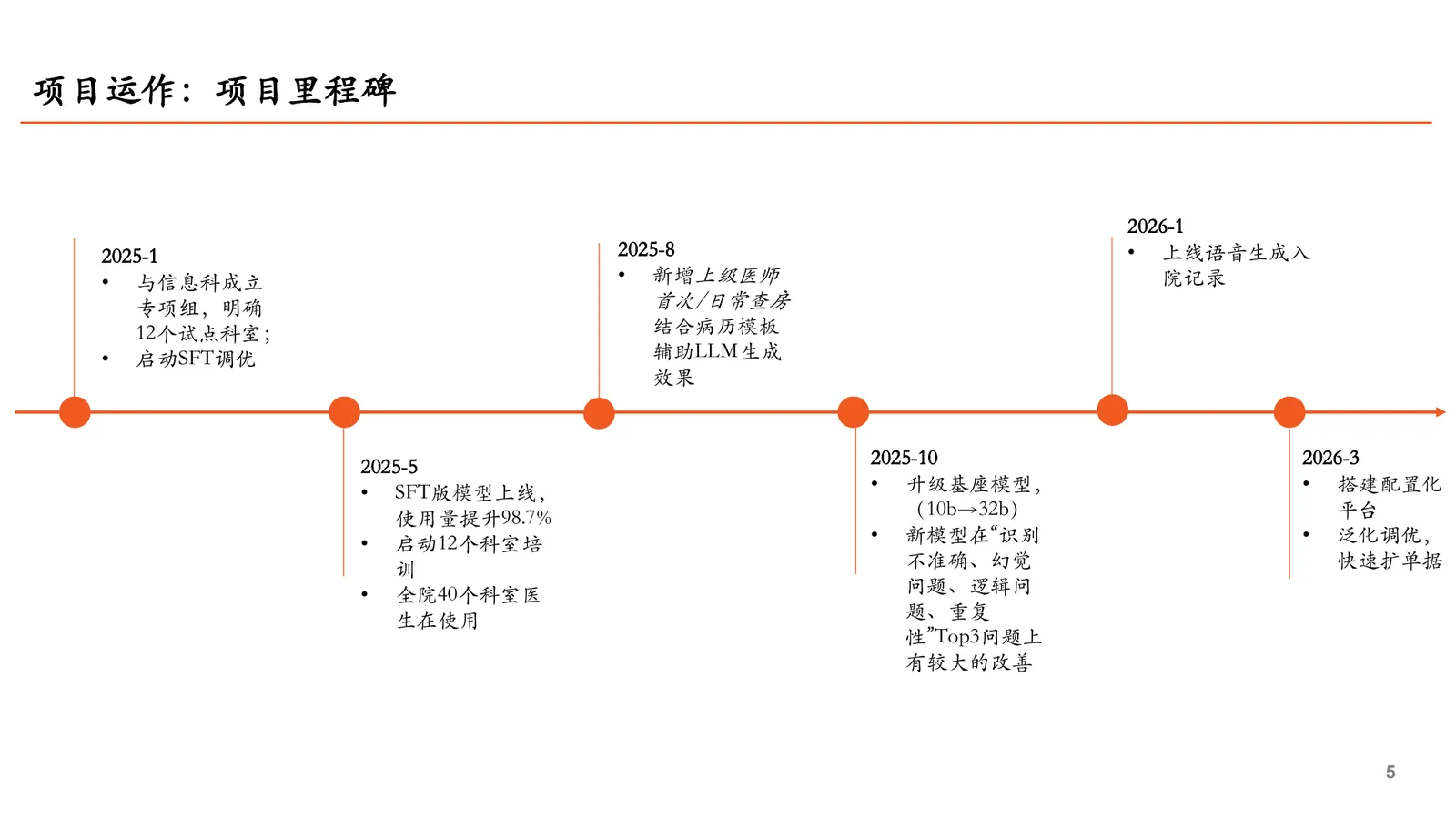
The step most easily overlooked is month 10. Replacing the base model was not about benchmark scores; it happened because frontline feedback had narrowed the complaints into four named failure modes. Without the preceding nine months of real use, that list would not exist, and there would be no basis for judging whether a model swap was worth it.
Part of the workflow, not a separate chat window
The product needs to be embedded in admission notes, progress notes, and discharge summaries rather than forcing clinicians to leave their existing system to “ask AI.”
A complete workflow has five steps:
- Input through voice, structured data, or existing medical records.
- Generation of a candidate document using specialty-specific templates.
- Quality control for missing fields, contradictions, institutional rules, and high-risk findings.
- Sign-off by the clinician, who accepts, edits, or rejects the suggestion.
- Feedback from every acceptance, edit, and rejection into the next iteration.
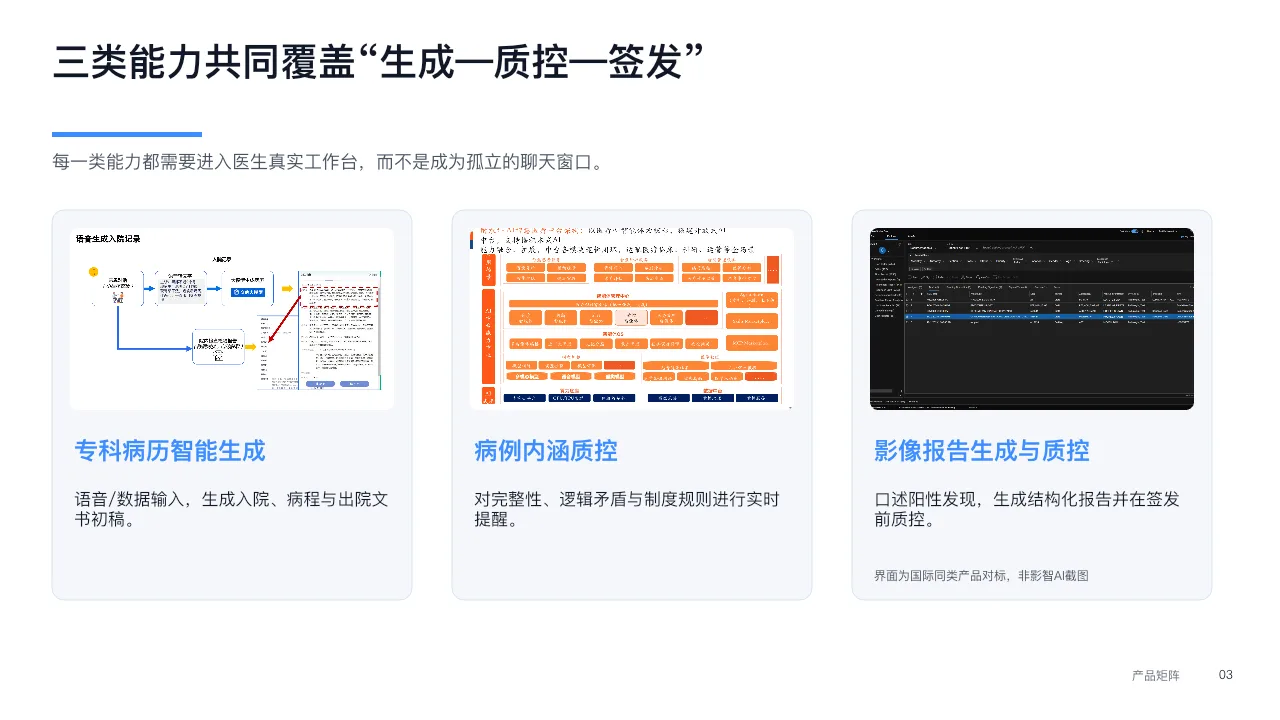
Three capabilities form one product matrix
| Capability | Work object | Primary value |
|---|---|---|
| Specialty record generation | Admission, progress, and discharge notes | Reduce repetitive writing and return attention to care |
| Content quality control | Completeness, logic, and institutional rules | Move review into the writing process |
| Imaging report generation and QA | Dictated findings and structured reports | Standardize expression and flag risks before sign-off |
They share data access, model services, rules, audit, and feedback. Each specialty still needs its own templates and terminology.
Voice is the entry point; the closed loop determines usability
Voice matches how clinicians naturally work: observing the patient while describing key findings. The system transcribes the interaction, suggests follow-up questions, and combines approved in-hospital data into a candidate record.
In the shipped product this chain has four steps: the clinician controls recording from the desktop workstation, the dialogue is transcribed live on screen, the system generates supplementary questioning suggestions once the conversation ends, and the admission note is generated and written back into the record with one click.
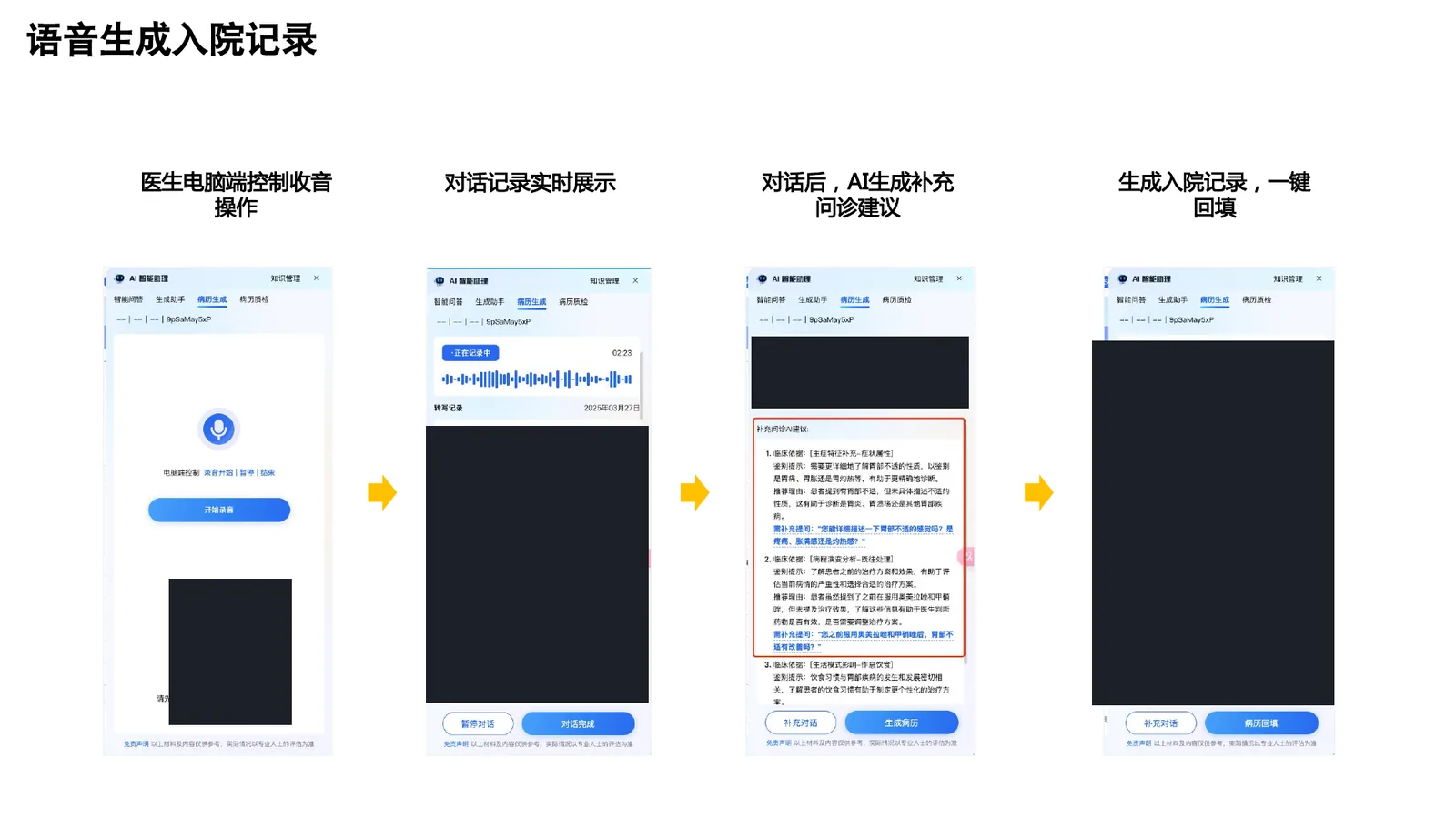
The third step deserves separate attention. The suggestion panel does not say “please add more history.” It is structured in three parts: clinical rationale (missing detail on the presenting symptom, evolution of the illness, lifestyle factors), differential prompts (why this piece of information would change the assessment), and a recommended reason — with the actual question to ask arriving last. That design places AI in the role of reminding the clinician not to miss something, not of drawing the conclusion. The accountability boundary is drawn at the interaction layer.
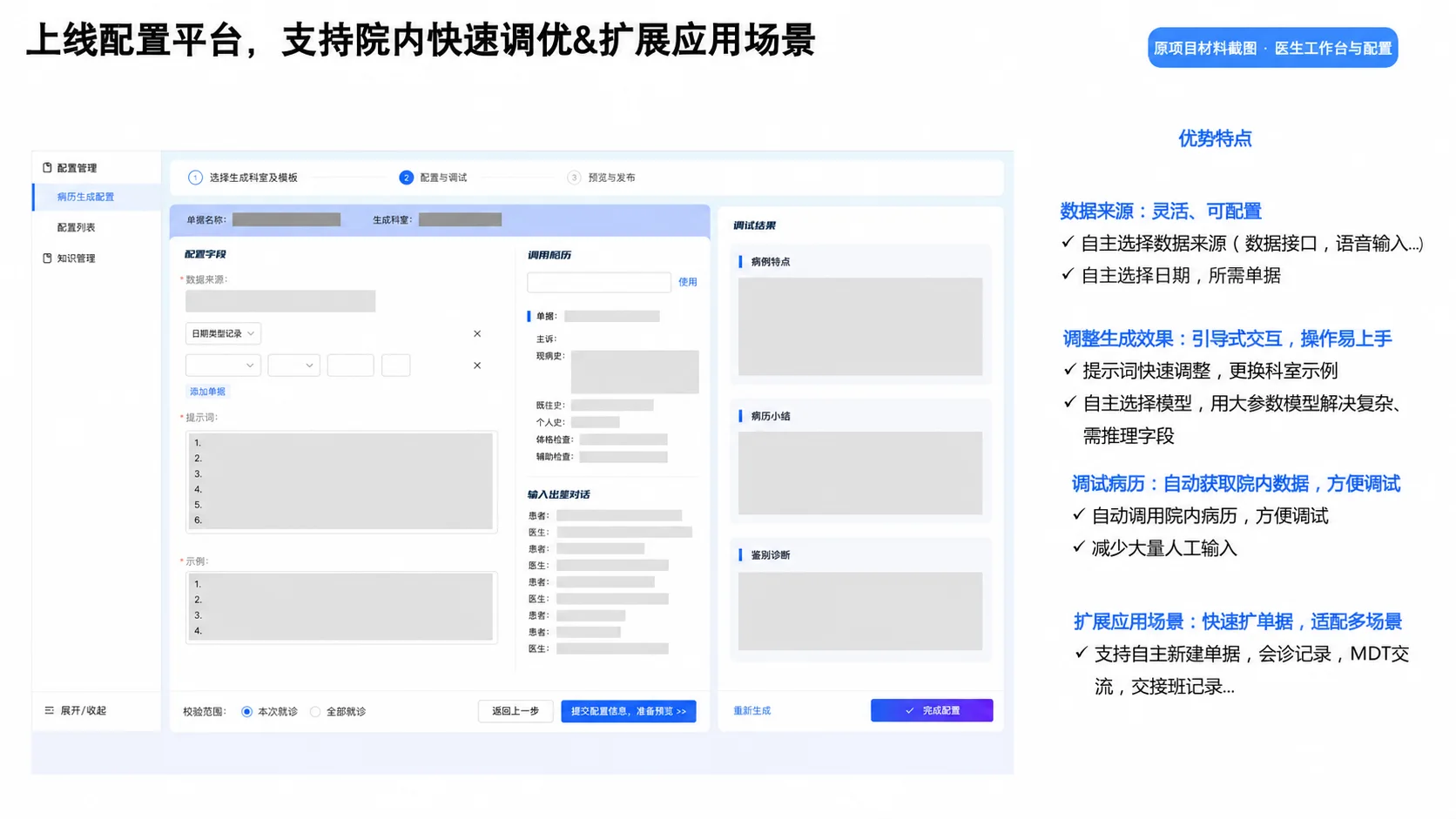
Usability depends on whether the product can:
- let clinicians choose and trace data sources;
- adapt prompts, templates, and specialty examples quickly;
- detect omissions during generation rather than after the fact;
- expand to consultations, MDT handoffs, and shift handovers;
- turn department feedback into the next iteration.
Different documents require different generation logic
| Document | Main inputs | AI task | Clinician review focus |
|---|---|---|---|
| Admission note | Conversation, history, tests | Organize complaint, history, examination, and initial assessment | Missing history and factual accuracy |
| Progress note | New tests, orders, and rounds | Explain changes and maintain a continuous timeline | Clinical reasoning and consistency with treatment |
| Discharge summary | Full stay, outcomes, follow-up plan | Summarize the episode and next steps | Diagnosis, medication, follow-up, and risk advice |
The reusable unit is therefore not one universal prompt. It is a shared platform combined with specialty templates, document rules, and clinician feedback. Every specialty needs a template owner, version history, and rollback process.
Department feedback must enter the product
The mobile and clinician-assistant interfaces in the material point to a direction: the clinician selects a patient, pulls up the recorded dialogue or an external report, and carries the result back into generation and quality control. Field order, phrasing conventions, template differences, and omission alerts raised by departments should land in the configuration platform as trackable iteration items rather than staying in a group chat.
One concrete change was “unbundling.” Recording and note writing had been fused into a single action; after department feedback they were decoupled, so the clinician chooses the patient, chooses which segment of the dialogue to use, and then decides what to generate. Data sources widened at the same time, from a single recording to photographed external reports with OCR, voice shorthand, and in-hospital lab results — with the original audio and the original report images still retrievable.
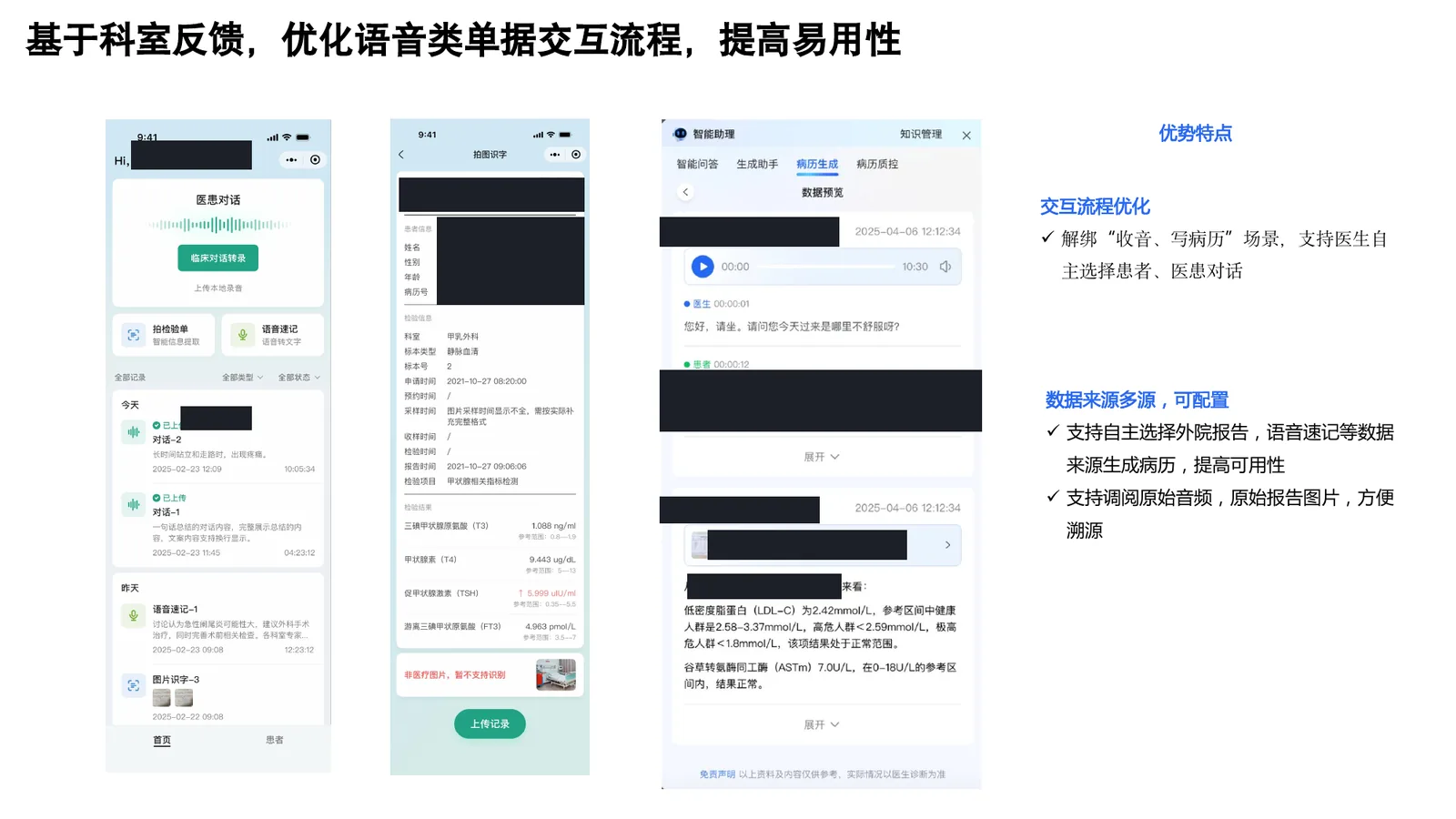
“Original audio and report images remain retrievable” reads like a minor feature. It is in fact the foundation of auditability. When generated content is disputed, whether anyone can return to that recording and that lab report determines whether the system can be admitted into the official documentation process at all.
An effective iteration records which passages were accepted, which were edited and why, which quality alerts were confirmed or dismissed, which source data supported the output, and how behavior differs by specialty, document type, and clinician experience.
Value must be measured for three groups
Clinicians
Reduce repetitive entry and formatting so attention returns to diagnosis and treatment.
Medical affairs and quality teams
Flag required fields, contradictions, and high-risk information before sign-off, reducing rework and dependence on retrospective sampling.
Hospital management
Turn validated templates, rules, terminology, and feedback into institutional knowledge instead of leaving them in individual experience.
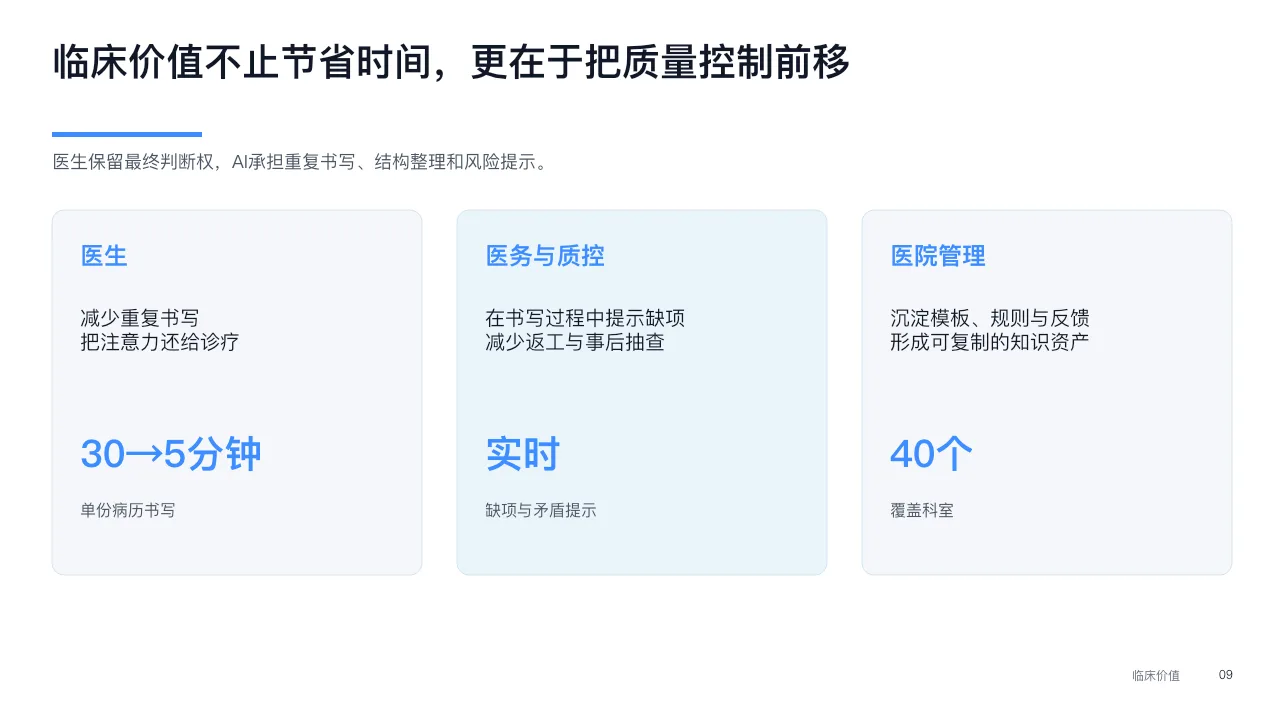
One set of figures disclosed in the stage material: inpatient documentation time down about 85% (roughly 30 minutes to 5 minutes per record), record quality up about 60%, average AI adoption around 61%; coverage of about 40 departments hospital-wide, about 258,000 documents generated cumulatively, and an average active rate above 71% in clinical departments. These figures are best treated as evidence that the product entered a real workflow, not as final outcomes without methodological review.
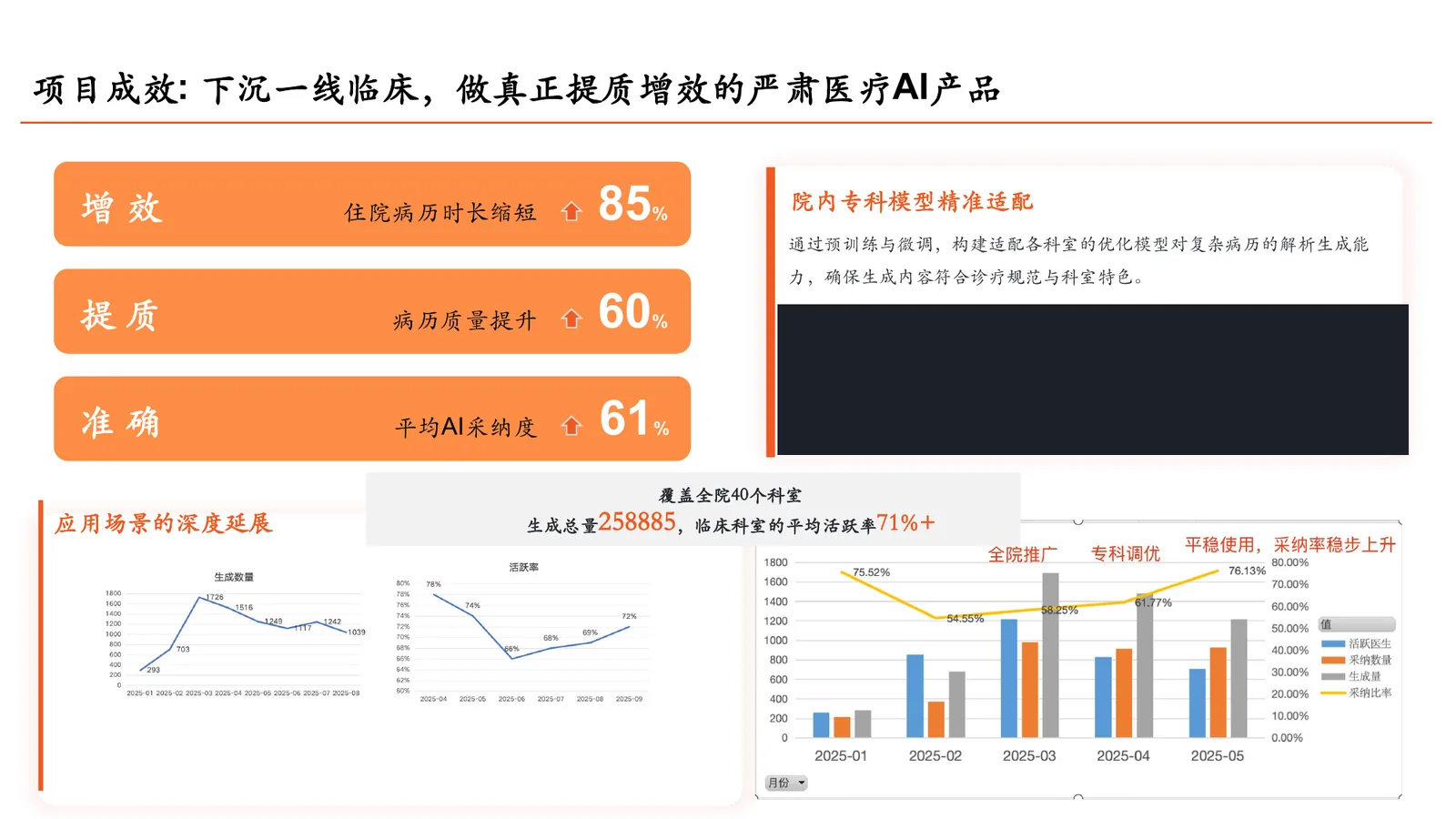
An adoption rate that dips before it rises is what real deployment looks like
That adoption curve deserves its own reading: 75.52% → 54.55% → 58.25% → 61.77% → 76.13%.
The 75% in month one belongs to pilot departments — few people, a narrow scope, participants who wanted to be there. In month two the rollout went hospital-wide and adoption immediately fell to 54%, because the user base shifted from people willing to try it to people required to use it, exposing every department difference, template mismatch, and terminology gap at once. Two months of specialty-level tuning brought it slowly back to 61%. In steady state it reached 76%, higher than during the pilot.
This U shape is close to universal in hospital AI rollouts. The real risk sits in month two: if 54% is read as project failure, the specialty tuning never happens. Whether an AI product survives is not determined by the first-month peak but by whether the team is prepared to sit through the second-month decline.
The active-rate curve over the same period traces the same shape: 78% → 66% → 72%. Generation volume tells a different story — it peaked at 1,726 documents in month three and then declined month over month to 1,039. That is not necessarily bad: early novelty-driven generation settled into stable real demand. But it carries a warning, generation volume must not become a core performance indicator, or departments will generate documents nobody needs in order to move the number.
The stage figures still need a methodology table
| Disclosed metric | Source value | What still needs definition |
|---|---|---|
| Documentation time per record | About 30 to 5 minutes | Document type, clinician sample, and whether review time is included |
| Inpatient documentation time reduction | About 85% | Whether it shares a source with the row above; how the baseline was measured |
| Record quality improvement | About 60% | Which scoring rubric, who scored, and whether scoring was blinded |
| Average AI adoption | About 61% | Field- or document-level definition of “adopted,” edit distance, and time window |
| Department coverage | About 40 | Distinguish live, pilot, and active use |
| Cumulative documents generated | About 258,000 | Measurement window; whether discarded and duplicate generations are included |
| Average active rate in clinical departments | Above 71% | Definition of active (login, generation, or adoption) and the denominator |
Defect rate, severe-defect interception, false alerts, edit volume, rework time, and clinician experience should be tracked alongside speed and adoption. Efficiency that rises while quality falls, or high adoption that depends on heavy rewriting, does not count as success.
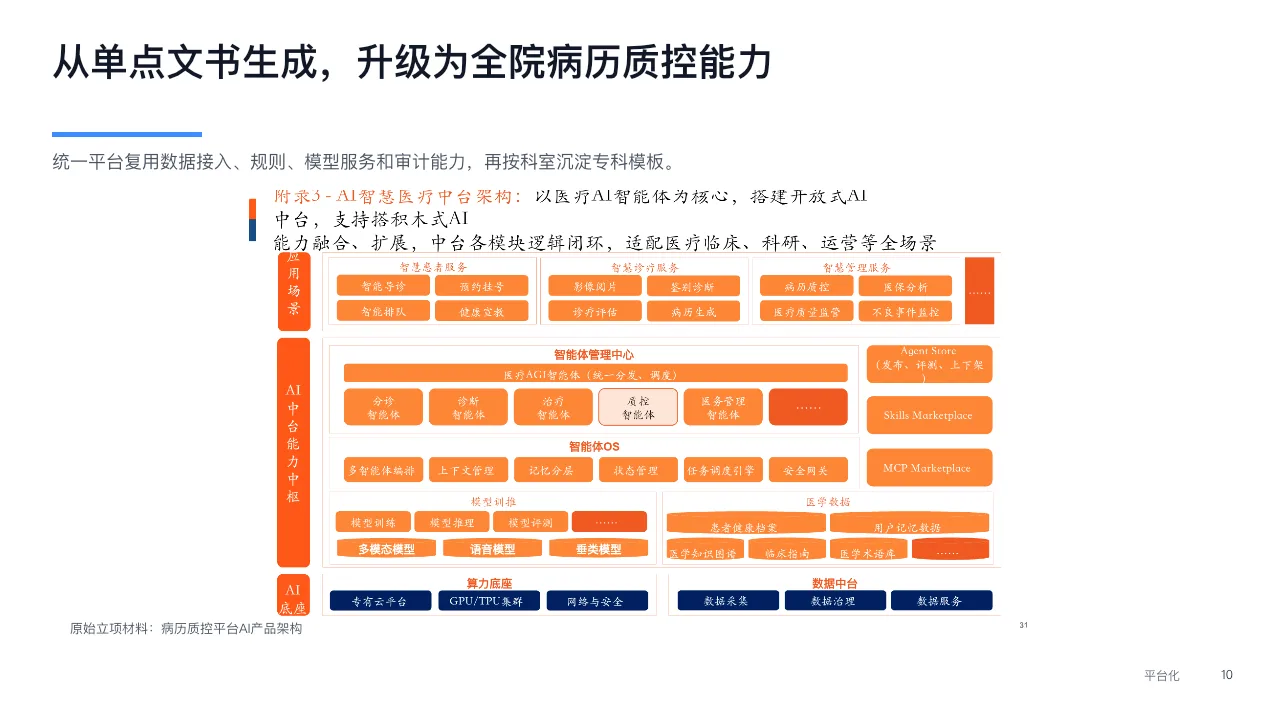
From a single generator to hospital-wide quality capability
A department can start with one high-frequency document, but scale requires a shared platform:
- unified access to in-hospital data under least-privilege controls;
- shared management of models, rules, prompts, templates, and versions;
- complete logging of input, generation, edits, rejection, and sign-off;
- common measurement of adoption, edits, defect detection, and clinician burden;
- specialty-specific knowledge on top of the shared foundation.
Documentation generation can then evolve from an isolated feature into hospital-wide medical record quality capability.
Four boundaries must be explicit before launch
- Data stays in the hospital with least-necessary access and full traceability.
- AI remains assistive and produces candidate documents or risk prompts, not formal diagnoses.
- Clinicians sign every official record after review and modification.
- Abnormalities are flagged in real time before sign-off, with evidence retained for audit.
Accountability must also be implemented in the system: every generated passage needs source, model, template, and timestamp metadata; acceptance, edits, rejection, and final sign-off must remain traceable; high-risk alerts cannot disappear silently; and model or template changes should pass staged validation with rollback available.
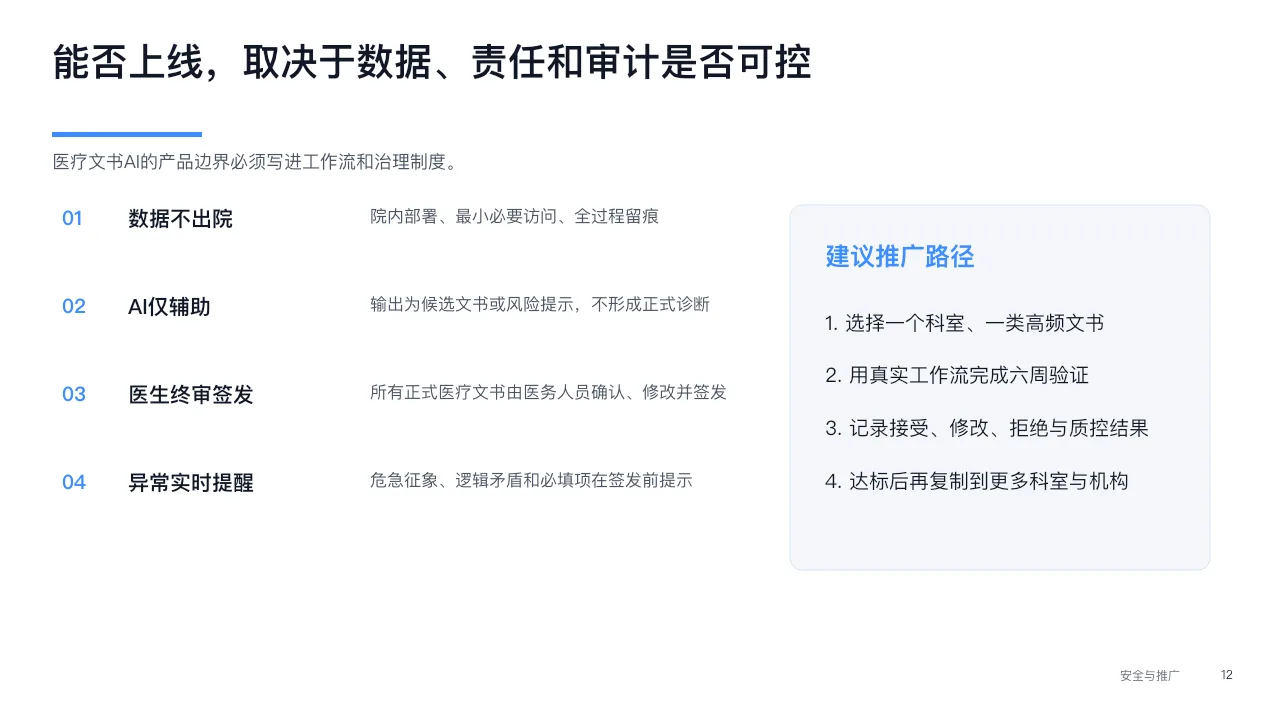
Begin with a six-week real-workflow validation
Choose one department and one high-frequency document:
- define data scope, accountability, and evaluation metrics;
- record every acceptance, edit, rejection, and QA result;
- observe clinician burden, document quality, and cycle time together;
- review false alerts, misses, rewrites, and incidents every week;
- replicate only after the validation threshold is met.
A six-week validation should establish the baseline and permissions in week one, enter limited real use in weeks two and three, adjust templates and interaction in week four, expand the sample in week five, and compare against baseline in week six. Quality, efficiency, experience, and safety must all pass before expansion.
Less writing for clinicians, more accurate documentation, and knowledge that keeps compounding.